
Leave Your Message
A reliable Mobile Power Bank should make everyday travel easier, not add uncertainty to your bag. For global buyers, the right choice depends on more than the largest capacity printed on the box. A compact unit may suit a commuter carrying a phone and earbuds. A frequent flyer may care more about clear capacity labeling, charging speed, and airline requirements. Details matter.
Battery engineer Elena Park offers this practical reminder: “Choose the power bank for the devices you carry, not the number that looks biggest.” Treat that as a buying principle, not a substitute for checking product specifications. Compare rated capacity with usable output, since energy conversion creates losses. Check whether the ports match your phone, tablet, or other gear. Then look closely at charging protocols, cable needs, weight, warranty terms, and the seller’s support.
Small differences show up fast. A heavy pack can feel awkward in a shoulder bag. A slow output may leave a phone barely charged before boarding. Clear documentation helps, too. It should state capacity, input and output ratings, and safety features in plain language. Still, specifications do not tell the whole story. Real-world performance varies with device use, temperature, and age, and buyers sometimes overlook that.
This guide presents ten practical buying tips for comparing options across markets. It will help you ask better questions, spot trade-offs, and choose a Mobile Power Bank that fits your routine. Don’t buy by capacity alone.
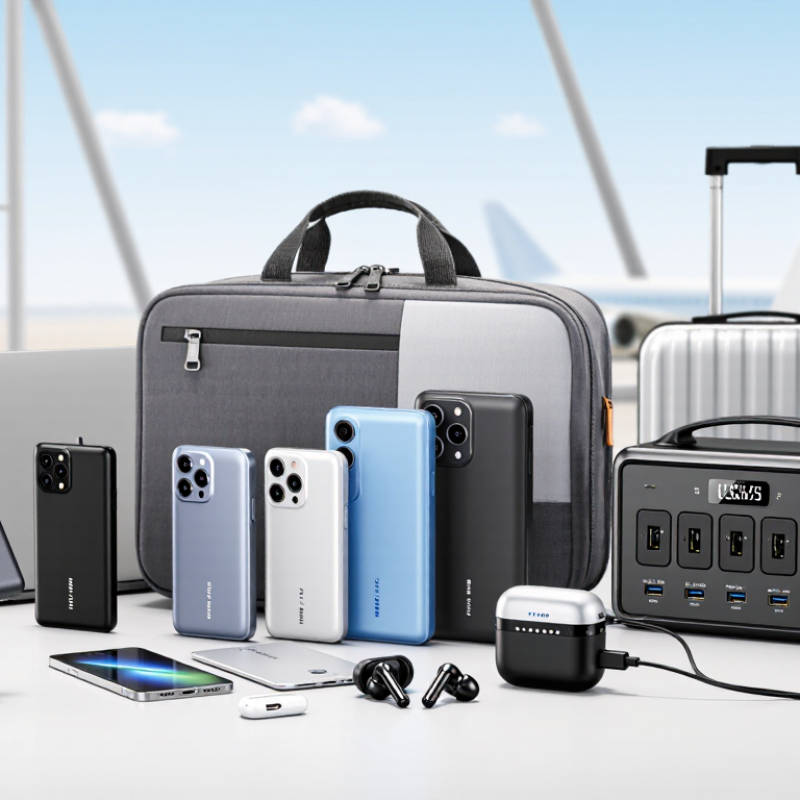
Choose capacity from the devices you actually carry, not the largest number on a shelf. List each battery rating and how often you recharge. A phone with a 5,000mAh battery needing one full recharge calls for more than 5,000mAh of bank capacity. Not the label. Power banks rate cells at their internal voltage, while phones receive energy after conversion losses. As a rough planning margin, allow 20–30% extra, then adjust for your devices and charging habits. This estimate is imperfect: cold weather, battery age, and active screen use can change results.
Compare energy ratings using watt-hours: Wh = mAh × voltage ÷ 1,000. A 20,000mAh pack rated at 3.7V stores about 74Wh. IATA’s 2024 passenger guidance identifies 100Wh as a key threshold for spare batteries; check current airline requirements before travel. IEC 61960-3:2017 sets out discharge-capacity testing for portable lithium cells, making clearly stated capacity and test conditions more useful than vague “charges” claims. A power bank rarely delivers its full rated mAh to a device. It usually won’t. For light daily top-ups, 10,000–20,000mAh may be enough; tablets and multiple devices often need more, with added weight.
| Tip | Device or buying factor | Practical capacity or specification guidance | What to check |
|---|---|---|---|
| 1 | List the devices you carry | A compact 5,000 mAh model may suit occasional top-ups; 10,000–20,000 mAh is a common range for regular phone use or several devices. | Include each device’s battery size and how often you expect to recharge it away from a wall outlet. |
| 2 | Estimate phone recharges realistically | Many smartphones have batteries around 3,000–5,000 mAh. A 10,000 mAh power bank often provides about 1–2 full phone charges, depending on device size and conversion losses. | Treat charge counts as estimates: power-bank capacity is measured internally, and not all stored energy reaches the device. |
| 3 | Allow for multiple days or users | A 20,000 mAh model can be more suitable for multi-day trips or charging more than one phone, while usually adding more weight and bulk than a 10,000 mAh model. | Choose based on the number of devices and days between reliable charging opportunities. |
| 4 | Account for tablets and larger batteries | Tablets commonly have larger batteries than phones; a 20,000–30,000 mAh power bank may provide useful extra capacity for tablet charging. | Check the tablet’s stated charging input and whether the power bank can supply the required output. |
| 5 | Check laptop energy and output needs | For USB-C-charging laptops, compare the laptop’s required wattage with the power bank’s USB-C output. Many laptops need substantially more power than phones, often 45 W or higher. | Confirm both USB-C Power Delivery support and the specific wattage required by your laptop; capacity alone does not guarantee compatibility. |
| 6 | Match charging speed to the device | A higher maximum output can support faster charging only when the device, cable, and power bank use compatible charging standards and power levels. | Compare the device’s supported input with the power bank’s port specifications, not just its advertised maximum wattage. |
| 7 | Consider how many devices charge at once | Multiple ports can charge several devices, but the available output may be shared when more than one port is in use. | Check the total combined output as well as the maximum output of each individual port. |
| 8 | Plan for recharging the power bank | Higher-capacity power banks generally take longer to recharge. A model with a higher supported input can reduce recharge time when paired with a compatible wall charger and cable. | Check the power bank’s input rating and whether your existing charger supports it. |
| 9 | Review airline rules before flying | Airline rules commonly use watt-hours (Wh) to assess battery limits. A 20,000 mAh power bank at a nominal 3.7 V is about 74 Wh; actual labeling and airline policies matter. | Check the airline and local aviation authority rules before travel. Spare power banks are generally required in carry-on baggage, not checked baggage. |
| 10 | Balance capacity against size and weight | Higher capacity usually means a larger, heavier unit. A smaller model may be easier to carry daily, while a larger one can suit longer trips or higher energy needs. | Compare the listed weight and dimensions with the capacity you will actually use. |
Note: mAh figures are not directly comparable across different battery voltages. Use the watt-hour (Wh) rating when comparing energy capacity, and treat estimated device charge counts as approximate because charging efficiency and usage vary.


 Mr. Leaf