Global buyers need chargers that travel easily, power several devices, and reduce packing clutter. A Gan Fast Charger uses gallium nitride switching components to support compact designs and efficient power conversion. The practical difference is visible: a smaller adapter can still charge a laptop and phone from one desk outlet. Small detail, big difference. Grand View Research estimated the broader GaN semiconductor devices market at about US$2.02 billion in 2023, with projected growth through 2030. That market includes more than chargers, so it signals technology momentum—not guaranteed charger sales.
Alex Lidow, co-founder of Efficient Power Conversion and a longtime GaN specialist, has described GaN as “the silicon of the 21st century.” The phrase captures its potential, but buyers still need to judge the finished product. A GaN chip alone does not guarantee safe temperatures, reliable charging, or broad compatibility. Check the charger’s stated input-voltage range, supported USB Power Delivery profiles, plug options, and independent safety certifications before ordering for different regions. One caveat matters. Compact chargers can run warm under heavy use, and performance varies by design. I have seen product listings emphasize wattage while leaving port-sharing behavior unclear; that deserves a closer look. For global buyers, the strongest choice balances portability with clear specifications, dependable support, and a design suited to real travel.

Why Is a GaN Fast Charger Better for Global Buyers?
Gallium nitride, or GaN, is a semiconductor used in power-conversion circuits. Silicon has served this role for decades. The key difference is material structure: the U.S. Department of Energy’s report on wide-bandgap semiconductors lists GaN’s bandgap at about 3.4 electron volts, compared with silicon’s 1.1. This wider bandgap lets GaN devices withstand stronger electric fields. In charger circuits, that can support faster switching and smaller components. The practical result may be a compact adapter with less energy lost as heat. It is not magic. Circuit design and cooling still matter.
Yole Group’s Power GaN market report forecasts continued growth in power GaN devices, reflecting their expanding use in power conversion. A market forecast is not proof that every GaN charger performs better, though. Buyers should compare rated output, supported charging protocols, plug compatibility, and measured temperatures—not just the material name. Picture a charger tucked beside a laptop in a crowded travel bag: smaller size helps, but only if the adapter stays stable under sustained load. GaN can make that balance easier to achieve. It cannot fix poor engineering. Sources: U.S. Department of Energy, “Wide Bandgap Semiconductors: Pursuing the Promise”; Yole Group, “Power GaN” market report.
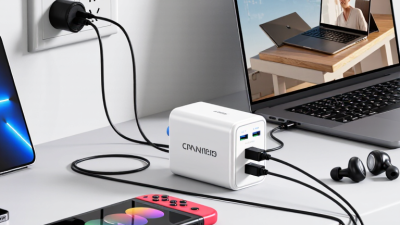
A GaN charger can deliver more power from a smaller enclosure because gallium nitride switches faster than conventional silicon. Faster switching lets designers use smaller transformers and other magnetic parts, while reducing energy lost as heat. In practice, that can mean a compact charger powering a laptop and phone from one outlet, with less warmth around its casing. The difference is useful in travel. It is not magic: circuit design and cooling still matter.
Efficiency is measurable, not just a selling point. The U.S. Department of Energy’s Level VI external-power-supply requirements set a no-load limit of 0.1 watt for many supplies rated at 49 watts or less. GaN does not automatically guarantee that result, but its lower switching losses can help designers meet demanding efficiency targets. The USB Implementers Forum’s USB Power Delivery 3.1 specification supports up to 240 watts, showing how much power modern charging systems can negotiate. Actual charging speed depends on the device, cable, and charger working together. A small charger may still run warm under heavy use; that detail is easy to overlook.
Why Is a GaN Fast Charger Better for Global Buyers?
Why Compact Size and Lower Heat Benefit Global Buyers
A GaN charger can deliver substantial power from a smaller body than many older silicon designs. Gallium nitride allows components to switch efficiently, helping manufacturers create compact chargers without sacrificing useful output. For travelers, that can mean more room for a camera battery or notebook in a carry-on bag. Less bulk matters. A charger that fits neatly beside a passport is simply easier to pack.
Efficiency can also reduce wasted energy, which may mean less heat during charging. But a GaN label alone does not guarantee a cool-running charger; power level, internal design, and ventilation matter too. A compact shell can feel reassuring, yet size alone proves little. On a hotel desk, a cooler charger may be more comfortable to handle and less likely to warm nearby items. Check its rated output and supported charging standards for your devices.
Tips: Look for wide input-voltage support when traveling, and confirm plug compatibility separately. Keep the charger uncovered while in use. If it becomes unusually hot, stop using it and check the manufacturer’s guidance.
A GaN charger can make travel easier, but universal voltage matters more than the small casing. IATA’s Global Outlook for Air Transport, published in December 2024, forecast 4.96 billion air passengers that year. For frequent travelers, one charger that accepts 100–240V input can work across many countries’ power systems. Check the charger’s printed input rating; GaN alone does not guarantee universal voltage. A plug adapter changes the plug shape, not the voltage. The detail matters.
Port support can reduce cable clutter in a hotel room or airport lounge. USB-IF’s USB Power Delivery 3.1 specification, released in 2021, supports negotiated power up to 240W with compatible devices and cables. In practice, a travel charger’s total output and port-sharing rules matter more than the headline maximum. Two USB-C ports may charge a laptop and phone together, but each can receive less power when both are in use. I still check the fine print. A compact charger is useful; an incompatible port or underpowered shared output is less so.
Input voltage ranges show how a universal-voltage charger can simplify travel.
A charger rated for 100–240 V can operate across both common voltage bands shown, so travelers generally need a plug adapter rather than a voltage converter. Check the charger’s input label and make sure its ports support your devices; a plug adapter may still be needed.
When choosing a GaN fast charger, start with your devices, not the biggest wattage printed on the box. Check the charging standard and input requirements for each phone, tablet, or laptop. A charger rated for 100 watts will not make every device charge at 100 watts. The device and cable must support the same power profile. Small detail, big difference.
Look at the output table, especially if the charger has multiple ports. Some models divide power when two devices are connected, so a laptop may charge more slowly beside a phone. Check the listed port combinations, not only the maximum single-port figure. For travel, confirm the input range and plug arrangement for your destination. A compact body helps, but a stiff cable can still make a crowded hotel outlet awkward.
Safety and build quality matter too. Look for clear electrical ratings and recognized safety testing for your market. GaN components can support smaller designs, but they do not remove heat. A warm casing can be normal; excessive heat, buzzing, or a burning smell means you should unplug the charger. It is easy to focus on wattage and overlook shared output. Compare port behavior, cable needs, and daily carry weight before buying.
| Comparison Point | Why GaN Can Be Better | What to Check | Practical Guidance |
|---|---|---|---|
| Size and power density | Gallium nitride (GaN) power transistors can switch efficiently at high frequencies, which can help designers reduce the size of some power-conversion components. | Compare the charger’s dimensions and weight with its rated output, rather than relying on the “GaN” label alone. | A compact design is useful for travel, but size varies by model and does not by itself prove performance or safety. |
| Charging speed | GaN can support compact, high-power charger designs; it does not independently determine how quickly a device charges. | Check the charger’s supported output profiles and whether they match the device’s charging protocol and power requirements. | The device, charger, and cable must all support a compatible charging mode for the intended speed. |
| USB Power Delivery and PPS | Many GaN chargers include USB-C Power Delivery (USB PD); some also support Programmable Power Supply (PPS). | Look for explicit protocol support and output-voltage/current profiles in the product specifications. | Do not assume every GaN charger supports USB PD or PPS, or that every device uses the same fast-charging protocol. |
| Multiple ports | A small GaN charger may provide several ports for charging multiple devices from one outlet. | Check both the maximum total output and the power available from each port when other ports are in use. | Port power may be redistributed when devices are connected or disconnected; consult the output table for the exact model. |
| Travel voltage compatibility | Compact chargers can be convenient for international travel, but GaN technology does not guarantee worldwide input-voltage support. | Read the input label. If it states “100–240 V, 50/60 Hz,” the charger is designed for that input range. | Check the destination’s plug shape separately. A plug adapter changes the physical connection; it does not convert voltage. |
| Cable capability | A suitable cable lets the charger and device negotiate supported power levels. | Confirm the cable’s rated current and power. For USB-C currents above 3 A, a suitable electronically marked (E-Marked) cable is required. | A high-wattage charger cannot deliver its full rated power through an under-rated cable or to a device that does not support it. |
| Heat and operating conditions | GaN switching characteristics can help enable efficient designs, but actual heat depends on the full charger design, load, and environment. | Check the manufacturer’s operating-temperature guidance and avoid covering the charger or using it in poorly ventilated spaces. | A warm charger can be normal under load. Discontinue use if there is damage, an unusual smell, or abnormal overheating. |
| Safety and regional compliance | The semiconductor material alone does not establish that a finished charger meets safety or regulatory requirements. | Check for applicable, verifiable safety and conformity information for the markets where the charger will be sold or used. | Requirements vary by region. Verify the specific model and documentation rather than relying on a generic claim or logo. |
| Value and product quality | A compact GaN design may suit buyers who value portability and higher output in a smaller form factor. | Compare specifications, protection features, warranty terms, and independent product testing where available. | Choose based on device compatibility and documented performance; GaN is a design technology, not a guarantee of quality. |
Note: Charger capabilities vary by model. Confirm the specifications printed on the charger and provided by its manufacturer before purchase or travel.