How to Choose the Best Mobile Car Battery Charger in 2026?
A dead battery rarely fails at a convenient time. It may happen in a cold driveway, outside an office, or after a short trip with the lights left on. A Mobile Car Battery Charger can help restore charge without waiting for another vehicle, but not every portable model suits every car. Some devices are compact and slow; others charge faster but take more space. The right choice depends on your battery, your routine, and where you expect to use it.
Start by checking your vehicle’s manual and the battery label. Confirm the battery voltage and chemistry, then compare them with the charger’s supported types. Look for clear ratings, reverse-polarity protection, overcharge safeguards, and straightforward status indicators. A screen showing charging progress can be useful in a dim garage. So can cables that reach the battery without stretching. Portability matters, too. A heavy unit may be reliable, but less convenient to carry in a small trunk.
Think about the situations you actually face. A charger for occasional home use may differ from one kept in a vehicle for travel. Also, a charger is not always a jump starter; check the product’s stated function before buying. Price alone tells little. Read the manual, warranty terms, and recent owner feedback, while treating dramatic claims with care. Even a well-reviewed model may not fit your needs. It is easy to overlook cable length or charging time until the first use. This guide explains how to compare practical features, avoid common mismatches, and choose with confidence—without assuming the most powerful option is automatically the best.
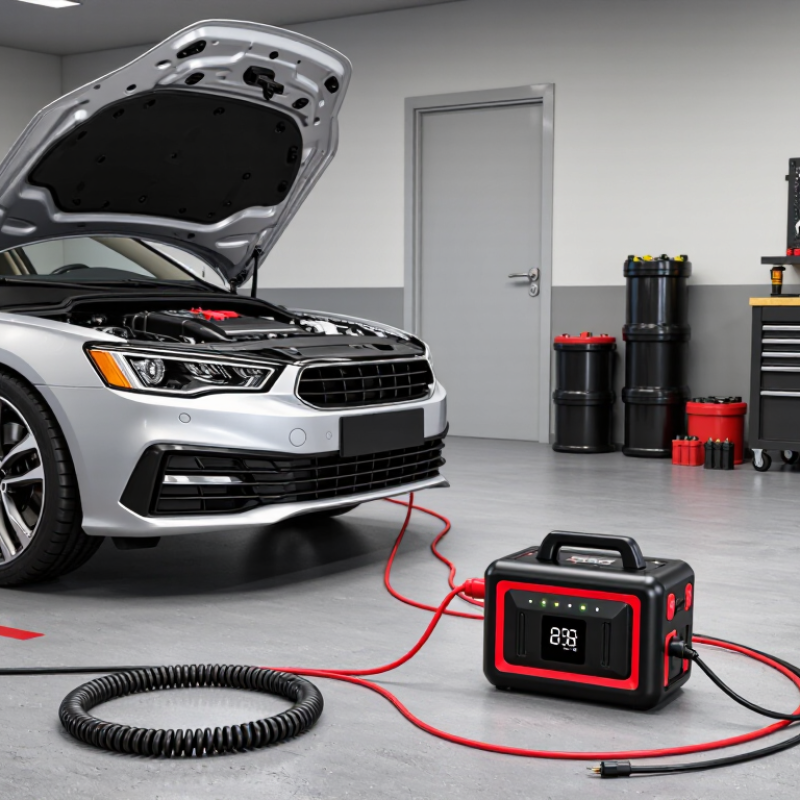
Identify Battery Chemistry and Capacity Before Comparing Charger Types
Before comparing charger types, read the battery label and identify its chemistry: flooded lead-acid, AGM, gel, or lithium iron phosphate (LiFePO4). These batteries need different charging profiles. A charger set for lead-acid may not suit lithium, even if the plugs fit. Check the vehicle manual too; labels can be hard to read under a dusty hood. Small detail, big difference.
Then note the battery’s voltage and capacity in amp-hours (Ah). A 12-volt battery rated at 70 Ah needs a charger designed for that voltage and a suitable current range; “more amps” is not automatically better. Match the charger’s chemistry mode and capacity guidance to the battery maker’s specifications. Battery Council International reports a 99% U.S. recycling rate for lead batteries, reflecting their established role in the market, but that figure does not make every lead-acid battery interchangeable. AGM and gel batteries still have distinct charging limits. I would double-check the label before buying; it is an easy step to rush.
How to Choose the Best Mobile Car Battery Charger in 2026? — Identify Battery Chemistry and Capacity Before Comparing Charger Types
| Battery chemistry |
Common 12 V capacity range* |
Charger profile to look for |
Typical charging-current guidance |
Key checks before purchase |
| Flooded lead-acid |
About 35–100 Ah for many passenger vehicles |
Automatic multi-stage lead-acid charging; use a flooded-battery mode if available |
A charge rate around 0.1C is a common conservative reference; follow the battery maker’s limit |
Provide ventilation; avoid sparks near the battery. Use equalization only if the battery manufacturer permits it. |
| AGM lead-acid |
About 35–100 Ah for many passenger vehicles |
AGM-compatible lead-acid profile with appropriate voltage control |
Choose current according to the battery specification; around 0.1C is a useful starting reference |
Confirm the charger explicitly supports AGM. Do not assume a flooded-battery equalization mode is suitable. |
| EFB lead-acid |
Often about 40–90 Ah in start-stop passenger cars |
Lead-acid charger compatible with EFB; a suitable standard or start-stop mode may be specified |
Use the battery maker’s recommended rate; roughly 0.1C is a common reference point |
Check the battery label and vehicle manual. EFB and AGM are both lead-acid, but their charging requirements are not automatically identical. |
| 12.8 V LiFePO4 (lithium iron phosphate) |
Capacity varies widely; confirm the battery label rather than relying on vehicle type |
Dedicated LiFePO4 charging mode with a suitable voltage profile |
Follow the battery’s stated maximum charge current and temperature limits |
Confirm the battery has an appropriate battery-management system. Do not use lead-acid equalization or desulfation modes unless the battery maker expressly allows them. |
| Unknown or mixed battery type |
Read the battery label or vehicle documentation |
Do not select a profile until the chemistry and nominal voltage are identified |
Avoid choosing current based only on physical battery size |
Check chemistry, voltage, Ah rating, polarity, and any vehicle-specific charging instructions. |
Compare charger types after confirming compatibility
| Charger type |
Best suited to |
Main advantages |
Limitations and checks |
| Low-current smart maintainer |
Keeping a compatible battery charged during storage |
Compact and convenient for long-term maintenance; automatic monitoring reduces the need for manual intervention |
Slow for recharging a substantially depleted, high-capacity battery. Verify chemistry support and maintenance-mode suitability. |
| Portable automatic charger |
Routine charging of a compatible 12 V car battery at home or on the road |
Offers controlled charging and may include several battery-specific modes |
Match its supported chemistry, output current, and input power to the battery and charging location. |
| Higher-current portable charger |
Faster charging when the battery and power supply allow a higher rate |
Can replenish a compatible battery faster than a low-current maintainer |
Higher current is not always appropriate. Check the battery’s maximum charge rate, charger duty cycle, cable rating, and required mains or vehicle power source. |
| Portable jump starter with USB or accessory outputs |
Starting assistance and powering small devices |
Useful for emergency starting and mobile-device power when properly rated |
A jump starter is not necessarily a battery charger. Check whether it explicitly provides a battery-charging function; many only deliver starting current. |
*Capacity ranges are broad examples for common passenger-vehicle batteries, not specifications for every vehicle. Battery capacities, charging limits, and voltage targets vary; use the battery label and vehicle or battery manufacturer’s instructions as the final reference.
Read the CCA Rating: SAE J537 Tests at −18°C for 30 Seconds
How to Choose the Best Mobile Car Battery Charger in 2026?
Read the CCA Rating: SAE J537 Tests at −18°C for 30 Seconds
CCA means cold cranking amps: the current a fully charged battery can deliver at −18°C for 30 seconds while staying above a specified voltage. This standardized test helps compare starting ability in cold weather. Check your vehicle manual or battery label for its recommended CCA. A small number on a battery can matter more than a charger’s flashy peak-current claim.
If you’re choosing a portable jump starter, compare its stated starting current with your car’s needs, but don’t assume its rating is directly interchangeable with the battery’s CCA. Manufacturers may describe output differently. Engine size, battery condition, and freezing temperatures also affect performance. A weak, damaged battery may not start reliably, even with a powerful device. Ratings are useful, not magic.
Tips: Match the device to your vehicle’s specified CCA, then check its operating-temperature range and safety protections. Keep it charged, and inspect the clamps for clean, firm contact. Read the instructions before connecting anything. That step is easy to skip—and worth reconsidering, especially in a dark, cold parking lot.
How to Choose the Best Mobile Car Battery Charger in 2026?
Read the CCA rating: SAE J537 cold-cranking tests assess a battery’s ability to deliver its rated current at −18°C (0°F) for 30 seconds while maintaining at least 7.2 V for a 12 V battery.
The values shown are illustrative battery CCA ratings, not test results or charger output ratings. CCA describes starting capability; when choosing a charger, also check that it supports your battery’s voltage and chemistry.
Match Charging Current to Capacity: 0.1C Is a Common Lead-Acid Guideline
A mobile car battery charger should suit the battery’s capacity, not just fit in the glove compartment. For many lead-acid batteries, 0.1C is a common charging-current guideline: multiply capacity in amp-hours by 0.1. A 60Ah battery, for example, points to about 6A. This is a starting estimate, not a universal limit. Check the battery maker’s instructions, because battery design, temperature, and condition can change the appropriate rate. A charger with adjustable output gives you more flexibility.
Tips: Check the battery label for its Ah rating and chemistry. Confirm the charger supports that type and has a suitable charging profile. Don’t assume a higher amp rating always means a better choice.
A current near 0.1C can offer a measured pace for many lead-acid batteries, but the charger’s voltage control matters too. In cold weather, a depleted battery may respond differently; heat can also affect charging. Automatic shutoff and reverse-polarity protection are useful safeguards, though they do not replace careful connection. I would treat the 0.1C figure as a practical check, not a promise of faster or longer battery life. A charger’s manual should settle the final choice.
Compare Voltage Modes, Recovery Features, and Compatibility
A useful mobile car battery charger should match the battery, not just fit in the trunk. Check the vehicle manual and battery label for nominal voltage and chemistry. Most passenger cars use 12-volt batteries; some larger vehicles require 24-volt equipment. Check the label. A charger with selectable voltage and charging modes offers flexibility, but the setting must match the battery. AGM, flooded lead-acid, and lithium batteries do not all accept the same charging profile.
Look for automatic charging stages that adjust current as the battery fills. A low-current maintenance mode can help when a vehicle sits for weeks. Recovery or desulfation modes may help some neglected lead-acid batteries, but they cannot repair a cracked case or restore every worn-out cell. That matters. Treat dramatic recovery claims cautiously, and stop if the battery becomes unusually hot, swollen, or emits a strong odor.
Compatibility includes more than voltage. Confirm the charger supports your battery’s chemistry, capacity range, and terminal layout. For roadside use, check cable length, clamp grip, weather resistance, and whether the unit needs a wall outlet or has its own power supply. Small details count. A compact charger is easier to carry, yet thin cables can feel awkward beside a dimly lit engine bay. I would compare the manual’s safety instructions before buying; people often overlook them when focused on charging speed.
Verify Charger Safety Certification: UL 1236 or IEC 60335-2-29
A mobile car battery charger sits beside fuel, metal tools, and a vehicle’s electrical system. Safety certification deserves close attention. UL 1236 covers battery-charger safety in the United States; IEC 60335-2-29 sets particular safety requirements for household and similar battery chargers. Check the exact standard number on the product or its documentation. A vague “safety tested” claim is not equivalent to independently verified certification.
Look for a recognized certification mark and verify the model in the certifier’s online directory. IEC compliance is a technical claim, not automatically proof of third-party certification. Read carefully. Also confirm that the charger supports your battery’s chemistry and voltage, and has protections against reverse polarity, overheating, and short circuits. These details matter when clamps are used in a cramped engine bay. I would still pause if the listing shows a certificate but no matching model number.
The broader risk is not theoretical: the National Fire Protection Association’s Home Electrical Fires report estimated an annual average of
31,647 U.S. home structure fires
involving electrical failure or malfunction from 2015 to 2019. That figure is not specific to battery chargers, but it shows why electrical safeguards deserve scrutiny.
Before buying, inspect the manual for ventilation guidance, approved battery types, and clear fault indicators. Small print matters.



 Mr. Leaf