How to Choose the Best Smart Power Bank for Your Needs?
In today’s digital age, staying charged is essential. A Smart Power Bank can be your lifeline. It ensures your devices remain powered during travel, work, or leisure. With many options on the market, selecting the right one may feel overwhelming.
Many factors influence this choice. Battery capacity, charging speed, and compatibility with devices are just a few. You might wonder if a higher capacity is always better. It often comes down to your specific needs. Not every user requires the same features. The variety may lead to buyer’s remorse, especially if you rush the decision.
Choosing a Smart Power Bank requires careful consideration. Take time to assess your devices and charging habits. Reviews and expert opinions can provide valuable insights. Remember, the ultimate goal is reliability and efficiency, tailored for your lifestyle.
Understanding Battery Capacity: mAh Ratings and Their Importance
When selecting a smart power bank, understanding the battery capacity is essential. The milliampere-hour (mAh) rating determines how much energy the power bank can store. A power bank rated at 10,000 mAh can charge a typical smartphone 2-3 times. User needs, such as device compatibility and charging speed, influence the required capacity.
Research shows that a power bank with a higher mAh rating may seem advantageous, but it often comes with trade-offs. Heavier and bulkier models may not be practical for everyday carry. A study by Consumer Reports highlights that the most portable models offer about 5,000 to 8,000 mAh. These can efficiently meet daily charging needs without adding excess weight to a bag or pocket.
Many technical experts recommend choosing a power bank with a balance between capacity and size. Power banks with 10,000 to 20,000 mAh are effective for multi-device users. However, they can lead to discomfort when carried for long periods. It’s crucial to consider how often you need to charge your devices and the physical aspects of carrying the power bank. Each user's lifestyle will dictate the ideal specifications.
How to Choose the Best Smart Power Bank for Your Needs? - Understanding Battery Capacity: mAh Ratings and Their Importance
| Power Bank Model |
Battery Capacity (mAh) |
Output Ports |
Fast Charging Support |
Weight (grams) |
Price (USD) |
| Model A |
20000 |
2 |
Yes |
400 |
29.99 |
| Model B |
15000 |
1 |
No |
300 |
19.99 |
| Model C |
10000 |
2 |
Yes |
250 |
24.99 |
| Model D |
30000 |
3 |
Yes |
500 |
39.99 |
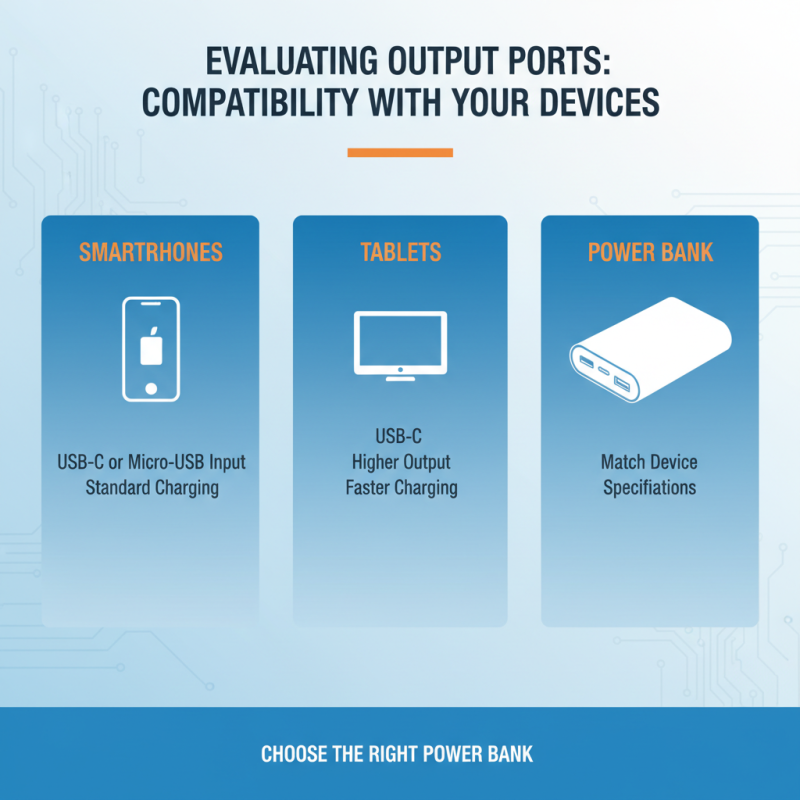
Evaluating Output Ports: Compatibility with Your Devices
When selecting a smart power bank, evaluating output ports is crucial. Your devices have different port requirements. For instance, smartphones may require a USB-C or micro-USB input. Tablets often need a higher output for faster charging, typically a USB-C. The right power bank should match these specifications.
Industry reports indicate that about 67% of consumers prioritize charging speed over other features. If your devices support Quick Charge technology, your power bank should too. Fast charging can significantly reduce downtime. Moreover, a versatile power bank with multiple outputs is often beneficial. It allows you to charge several devices at once, which is efficient, especially when traveling.
Compatibility can be tricky. Some power banks claim broad compatibility, but performance may vary. It's not uncommon for users to find their devices charging slowly or not at all due to mismatched specifications. A review of consumer reports shows that users feel misled about charging capabilities. Take time to research and verify compatibility before making your choice. A smart choice today avoids frustration tomorrow.
Assessing Charging Speed: Quick Charge Technology Explained
When choosing a smart power bank, charging speed is crucial. Quick Charge technology has revolutionized how we think about recharging devices. According to a report by the International Data Corporation (IDC), over 50% of consumers value charging speed as their top priority. Quick Charge capabilities can charge compatible devices up to four times faster than traditional methods. This speed can be a game-changer for modern lifestyles.
Understanding Quick Charge is essential. It adjusts voltage and current to optimize power delivery. For example, a standard USB port typically delivers 5V at 1A, providing a mere 5W of power. In contrast, Quick Charge can push up to 18W or more, dramatically reducing charge times. However, not all devices support this technology. Users must ensure compatibility between their power bank and devices. This mismatch can lead to disappointing charging performances.
Not every situation is perfect. While Quick Charge is effective, it may cause heat buildup, which can potentially shorten battery lifespan. Many users overlook this factor. Selecting a power bank involves more than just speed—it requires careful consideration of safety features. Reports indicate that consumers should choose power banks with built-in protections against overheating and overcharging. These features ensure longevity and reliability for your devices.
Charging Speed Comparison of Smart Power Banks
Portability and Design: Balancing Size and Capacity
When choosing a smart power bank, portability and design play crucial roles. A report by Statista indicates that 36% of consumers prioritize size when selecting portable chargers. People want a device that fits easily into their bags or pockets without adding bulk. This is why the trend leans toward slimmer designs that still offer substantial power.
However, balancing size and capacity can be challenging. Many users desire power banks with at least 10,000 mAh for adequate charging. Yet, such capacity can lead to heavier products. Research shows that power banks under 300 grams are generally considered portable, but they often provide limited charges for modern smartphones. Finding a lightweight power bank that still offers high capacity can feel like an impossible task.
Furthermore, aesthetics matter. Consumers are drawn to power banks that match their personal style and preferences. A sleek design can enhance the overall user experience. Despite these desires, many models sacrifice design for functionality or vice versa. Reflecting on individual needs can help to make a smarter choice. Balancing portability with capacity in a visually appealing device requires careful consideration.
Safety Features: Protecting Your Devices from Overcharging and Short-Circuiting
When selecting a smart power bank, safety features play an essential role. Overcharging can damage your devices. It can also lead to malfunction or even fire hazards. Look for banks with intelligent auto-detection. This feature adjusts the charging current. It prevents battery overheating during use. Not all power banks offer this protection. This is a critical point to consider.
Short-circuiting is another significant risk. A quality power bank will have internal fuses or circuit breakers. These components act as barriers against electrical faults. Without these, your device and the power bank could become damaged. Reading user reviews can reveal real-life experiences with safety features. Some may provide insights on how well these systems work.
Not every power bank has robust safety mechanisms. You might find a model lacking in protective features. This is a reminder to research thoroughly before purchasing. Prioritize understanding safety standards. A power bank is a small investment for peace of mind. Protecting your devices should always be a priority.





 Mr. Leaf